
What is Unique Fields for Custom Objects?
Unique Fields is a data-integrity setting that you can enable on selected custom-object fields. When a field is marked as unique, Enrollio checks every new or updated record and blocks any value that already exists in your account. This ensures every custom-object record stays truly unique and eliminates messy deduplication projects down the road.
Key Benefits of Unique Fields
- Stop duplicates: Enforce unique fields at creation and update so repeats are blocked across the interface, forms, automations, imports, and API.
- Accurate reporting: Preserve true one-to-one relationships so dashboards, attribution, and metrics stay trustworthy.
- Safe automations: Protect bulk imports and automation actions from accidental double-creates with built-in pre-checks.
- Future-ready: Establish the foundation for upcoming advanced deduplication and merge capabilities.
Rules, Limits & Field Support
- Mark custom fields as unique during creation
- Limit of 10 unique fields per object (applies across your account)
- Enforced across all record creation methods — manual entry, automations, forms, and APIs
- Supported field types:
- Single Line Text
- Multi Line Text
- Number
- Phone
- Allows downgrading a unique field to non-unique (irreversible action)
How to Mark a Field as Unique in Custom Objects
Option 1: While Creating a New Custom Field
- Navigate to Settings
- Click Custom Fields
- Click + Add Field
- Select a supported field type (Single Line, Multi Line, Number, or Phone)
- Enter the field name, object, and group
- Check the box for Mark Field as Unique
- Click Save
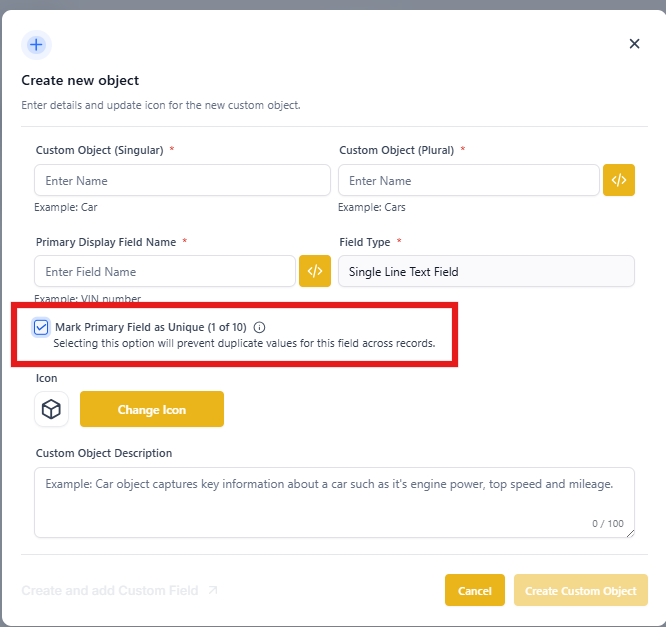
Option 2: Marking a Primary Field as Unique While Creating Custom Object
- Go to Settings
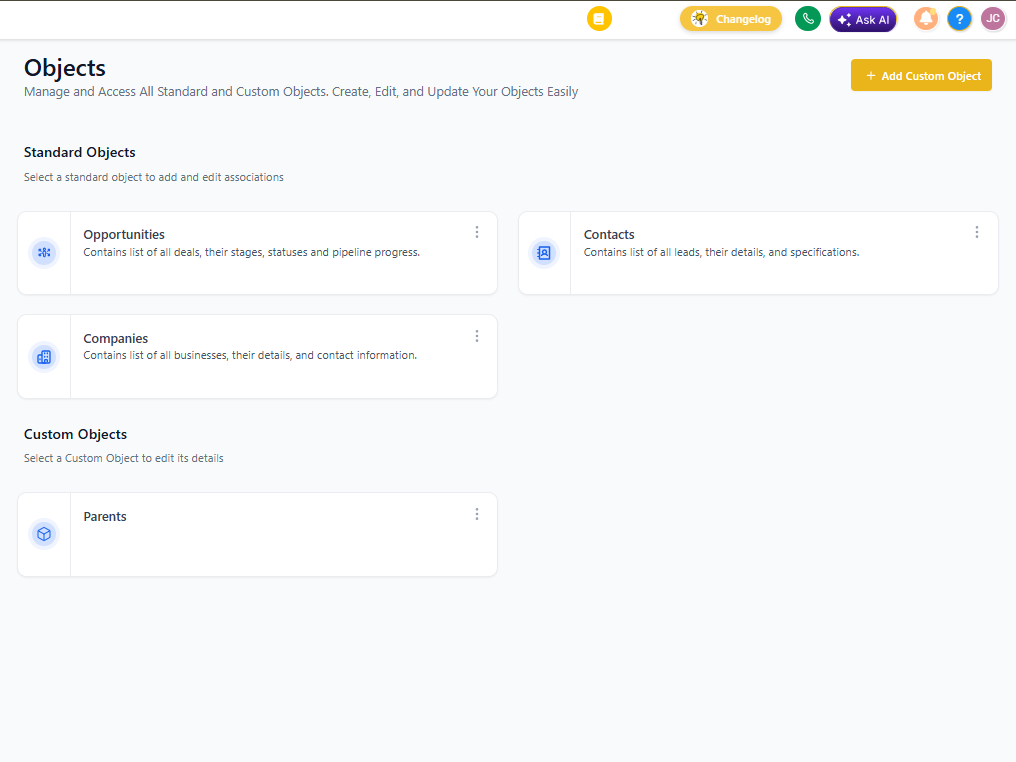
- Click Objects
- Click + Add Custom Object
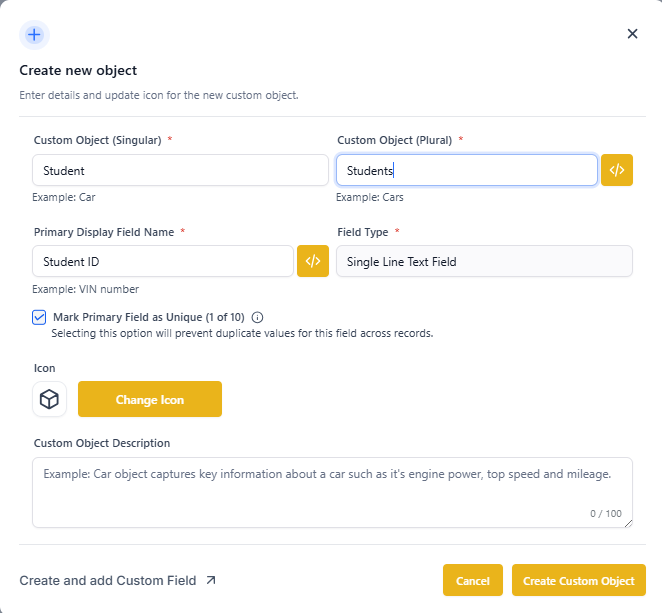
- Define the Custom Object Name and Primary Display Field
- Check Mark Primary Field as Unique
- Click Create Custom Object
This ensures the primary field (for example, Student ID or Registration Number) cannot have duplicates.
How to Modify Unique Fields
Note: Once downgraded from unique to non-unique, it cannot be made unique again.
- Go to Settings Custom Fields
- Find or search the unique custom field
- Select the field
- Click Bulk Actions Edit
- Deselect Mark Field as Unique option
- Save changes
Example Scenarios
| Scenario | Action | Result |
|---|---|---|
| Two records have the same value in a Primary field | User saves | Error: "A record with the same value already exists." |
| Two records with the same value in a non-primary unique field | User saves | Partial success – duplicate rows skipped with warnings |
| Field marked as unique, then user attempts deletion | Delete | Warning – field cannot be deleted |
| Unique field downgraded to non-unique | User saves | Allowed, but irreversible |
| API used to update with duplicate value | Update call | API returns validation error |
Best Practices
- Use unique fields for identifiers or keys (for example, Child ID, Enrollment Number, Staff Code)
- Avoid marking frequently updated text fields as unique
- Before imports, deduplicate data externally to prevent import warnings or skips
- Plan field uniqueness early — re-enabling unique later is not supported
Frequently Asked Questions
Does uniqueness apply account-wide?
Yes. Uniqueness is enforced globally across your entire account.
Is the check applied on updates as well as creates?
Yes. Both create and update actions are blocked if the unique value already exists.
What error do users see on a duplicate?
You'll see a message like: "A record with the same value for <fieldName> already exists."
Where is uniqueness enforced?
Across all entry points: manual record creation, automations, and forms.
Can I mark a dropdown or email field as unique?
Only Single Line, Multi Line, Number, and Phone fields are supported in this release.
What happens during a CSV import if duplicates exist?
The import finishes, but rows with duplicate unique-field values will fail.
Do uniqueness checks slow down API bulk inserts?
No. The validation is optimized at the database layer, so performance impact is negligible even for large batches.
Related Articles
- Getting Started with Custom Objects
- Creating and Editing Custom Objects
- Creating and Updating Custom Object Records
- Using Custom Objects in Automation Actions and Triggers